Airlines must limit BD-500 takeoffs in dense freezing fog by Dec. 21
2 minute read
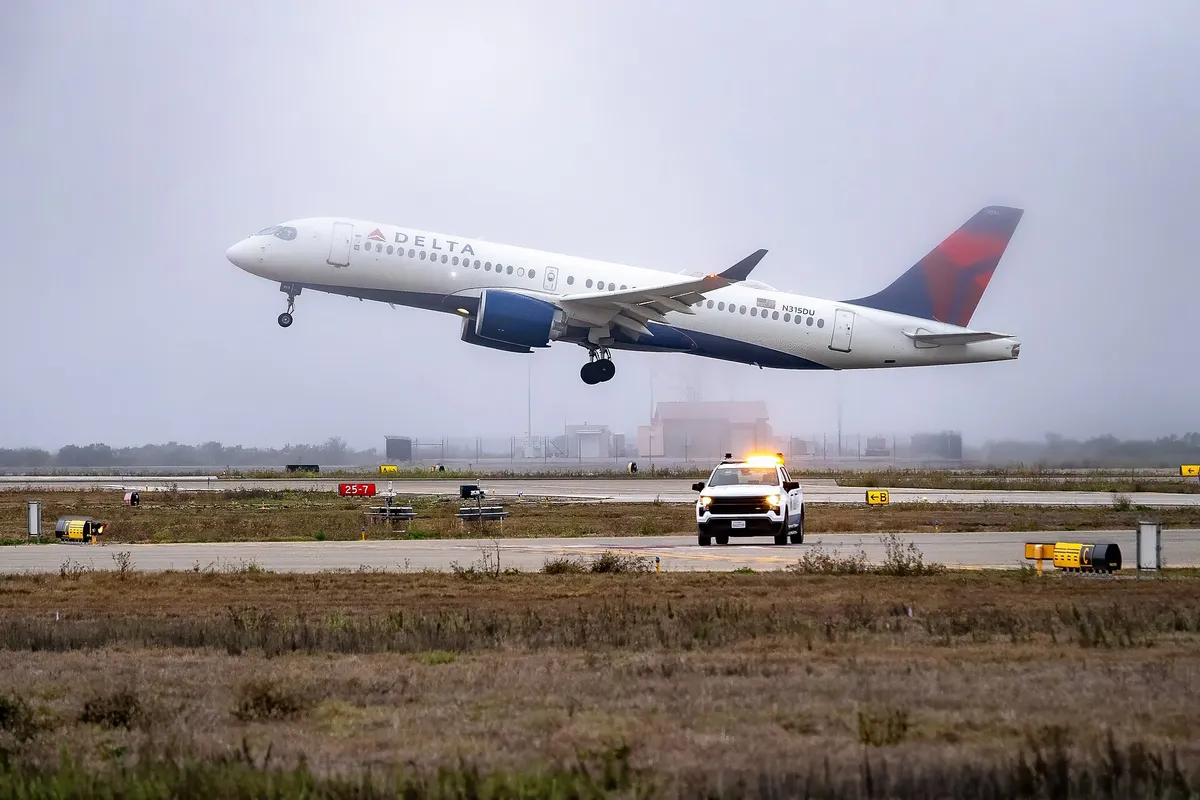
Airlines flying Airbus Canada BD-500 jets in the U.S. have until Dec. 21 to write a new limit on takeoffs in dense freezing fog into their flight manuals, after reports of engines stalling on the ground as they powered up for takeoff.
A Federal Aviation Administration directive takes effect Monday, Dec. 14, and gives operators seven days from then to revise the manual. It reaches every BD-500-1A10 and BD-500-1A11, an estimated 228 airplanes on the U.S. register.
"Engine stalls during take-off could result in loss of thrust and dual engine shutdown during critical phases of flight," the FAA wrote in the rule.
Crews face a takeoff restriction when ground freezing fog cuts visibility below 150 meters (500 feet). It sits in the manual's non-normal procedures, under ice and rain protection.
Stall reports came from Airbus A320 airplanes fitted with Pratt & Whitney PW1100G-JM engines. That engine's design resembles the Pratt & Whitney PW1500G, so Transport Canada said it couldn't rule out the same problem in the PW1500G.
Canada's aviation authority issued its own directive, AD CF-2026-53, on Oct. 21, 2026. Its U.S. counterpart follows that order.
Seven days is shorter than a public comment period would allow, the FAA said, and it named cold-weather flying as the reason for the tight deadline. "The FAA has found that the risk to the flying public justifies forgoing notice and comment prior to adoption of this rule," the agency wrote.
By the FAA's estimate, each airplane needs one work-hour at $85 an hour, or $19,380 across the U.S. fleet. No parts are needed.
Valves in the bleed air system are the target of a second directive, which takes effect Wednesday, Dec. 30. Those pressure regulating shutoff valves let crews isolate the system once a leak turns up, and several have failed in service.
Left alone, a failure could lead to "loss of functionality for assisted engine start capability, cabin pressurization, fuel tank inerting, and wing anti-ice systems," the FAA said.
Pilots get new steps for a BLEED LEAK caution message that won't go away. They throttle back or shut the engine down.
In known or forecast icing, airplanes can't fly under certain minimum equipment list provisions when the only working valve is one of the affected parts.
Airlines must also swap those valves for improved ones within 9,350 flight hours from Dec. 30. An estimated 112 airplanes on the U.S. register are covered.
First proposed on March 24, 2026, the bleed-leak rule drew support from the Air Line Pilots Association, International, which asked for no changes.
Comments on the freezing-fog directive are due to the FAA by Monday, Jan. 11, 2027.
You May Also Like

Leuven police fine 13 cyclists for red lights in checks at the station
Running red lights was the offence police found most often among cyclists…
FAA seeks fixes for fuel leaks and rotor cracks on 206 U.S. Airbus aircraft
Six FAA actions, each adopting a directive from the European Union Aviation…
London police to test kit reading drones' number plates after event disruption
London, UK: a nearly £2 million trial will give police equipment that…
Boeing 737 and 757 jets face new FAA safety checks starting Dec. 7
Two FAA directives require roll-control tests on Boeing 737s and fuselage repair…